



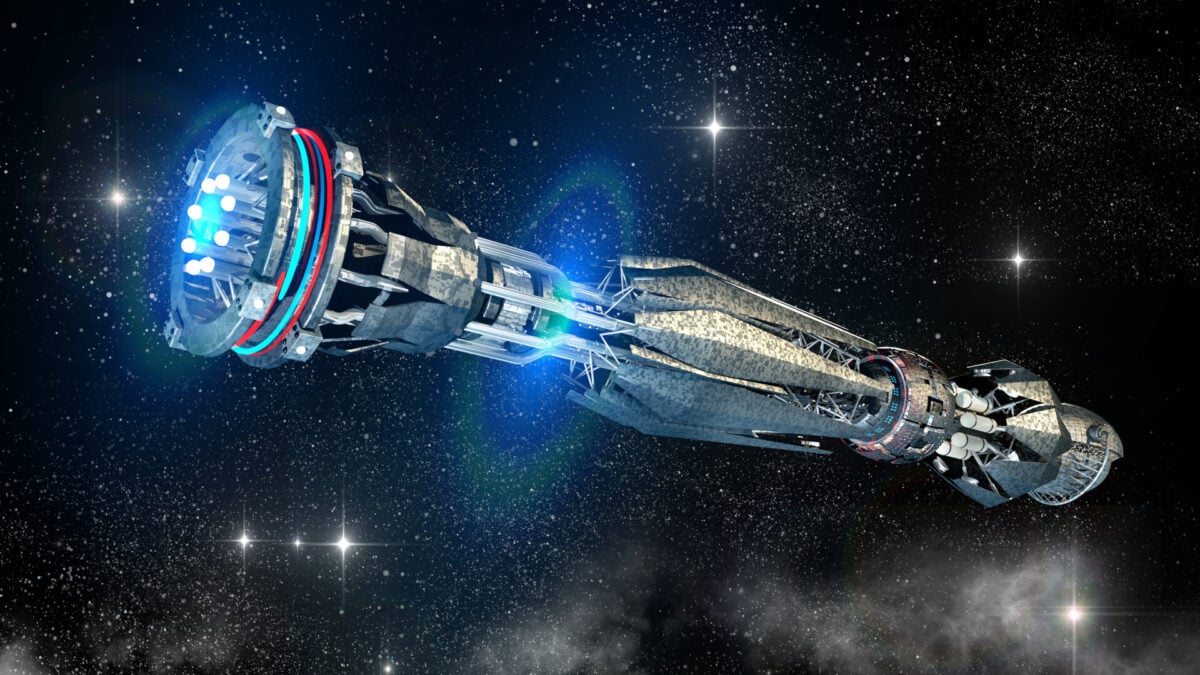
Humanity’s quest for deep space exploration is driving innovative propulsion methods. Conventional rockets would take thousands of years to reach Alpha Centauri, our nearest star, prompting researchers to explore light-based propulsion as a faster, more sustainable alternative. A team from Texas A&M University has successfully demonstrated the use of lasers to manipulate small devices without direct contact. Their findings, published in Newton, indicate that light propulsion could one day facilitate missions to distant stars.
The concept of using light for propulsion isn’t new; photons carry momentum that can exert thrust on objects. Previous methods like solar sails have used this principle, and the Texas A&M team has advanced it with their creation, the MetaJet—a micron-scale device smaller than a human hair. This ultra-thin material features etched patterns acting like lenses, enabling scientists to control light’s behavior when reflecting off the device.
This innovative design allows for precise 3D maneuverability, a significant advancement over earlier lightweight propulsion research. Experiments were conducted in a fluid environment to negate gravity while observing the device’s motion. While the MetaJet is tiny, researchers believe that scaling the concept could allow for larger objects in the future.
The propulsion force is based on the light’s output rather than the object’s size, suggesting potential for a 20-year journey to Alpha Centauri if expanded for larger spacecraft. The researchers plan further tests in microgravity to evaluate the device’s performance. Additional exploration in this field includes experiments by the European Space Agency using laser beams on materials like graphene aerogel, promoting the idea of propellant-free space travel.
