



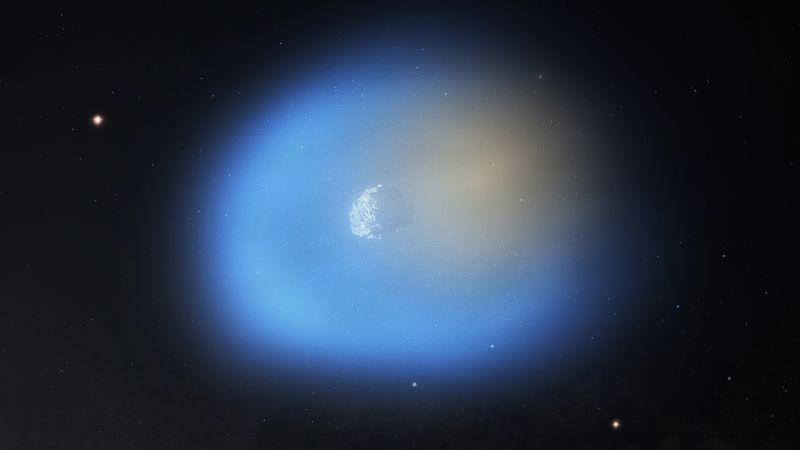
Astronomers studying the interstellar comet 3I/ATLAS have gained new insights into its formation and origins using observations from the Atacama Large Millimeter/Submillimeter Array (ALMA). First spotted in July, this comet is only the third known interstellar object entering our solar system, having begun its exit in December.
Recent findings published in Nature Astronomy reveal that 3I/ATLAS contains deuterium, a heavier isotope of hydrogen, in concentrations over 40 times higher than that found in Earth’s oceans. This indicates it formed in much colder conditions—less than 30 degrees Kelvin—compared to our solar system, suggesting that it originated from a primitive planetary system around 11 billion years ago.
The unusual deuterium presence supports theories that these comets hold clues about the environments where they were formed. While the comet did not show detectable levels of regular water (H2O), its detection of deuterium is considered a significant and surprising finding, indicating its unique composition.
Future studies at the Vera C. Rubin Observatory may help researchers compare other interstellar comets to 3I/ATLAS, enhancing our understanding of the evolutionary history of the galaxy and the conditions under which other planetary systems formed. Astronomer Dr. Theodore Kaleta emphasized that studying these objects can reveal the composition of the early galaxy, shedding light on the changing nature of comet formation and its implications for planetary development over time.
