



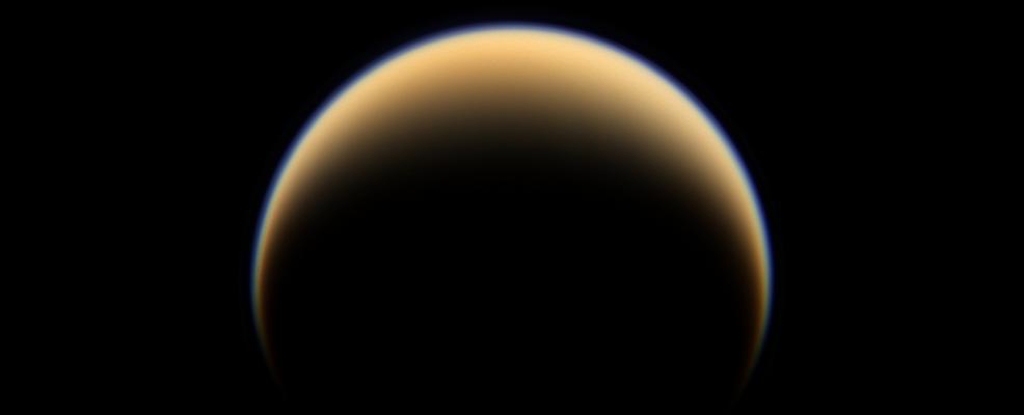
Titan, Saturn’s largest moon, may harbor hidden oceans, but new research suggests its potential biosphere could be limited to a minimal amount of life comparable to a miniature poodle. Antonin Affelder, an evolutionary biologist, states that Titan’s energy and nutrient cycles might insufficiently support even a single fermented cell per liter of deep sea.
Titan possesses unique features in the solar system, rich in organic content. Hydrocarbons on its surface exist as liquid at frigid temperatures and form rivers and lakes. Research indicates Titan resembles a layered jawbreaker candy with a rocky core and salty underground sea, covered by a thick layer of water ice. Organic molecules from Titan’s atmosphere fall onto the surface, enriching the underground seas.
A new study explored whether these organic molecules could sustain a marine microbial community. Researchers suggest that if life exists, microbes could use anaerobic fermentation for energy, akin to certain Earth processes. Glycine, an amino acid common in the universe, may serve as nourishment, but only a small fraction of organic material in Titan’s seas is suitable for life.
The research concludes that any potential life on Titan could be minimal, estimating the total biomass at only a few kilograms, equivalent to a small dog. Consequently, detecting living cells in Titan’s vast oceans would be exceedingly challenging, akin to finding needles in a haystack. This study was published in the Planetary Science Journal.
Source link
