



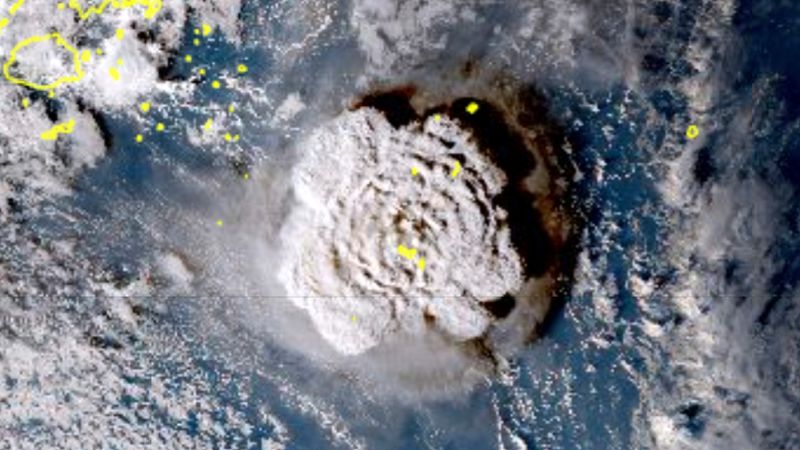
In January 2022, a significant volcanic eruption from Hunga-Tonga-Hunga-Ha’apai in the South Pacific released ash and gases, creating a surprising effect: the destruction of some of its own methane emissions. Researchers discovered a formaldehyde cloud, which indicates a breakdown of methane, a potent greenhouse gas.
The eruption, immensely powerful—hundreds of times stronger than Hiroshima—resulted in a massive plume that mixed saltwater vapor and volcanic ash. This combination, when exposed to sunlight, generated chlorine atoms that helped decompose the methane released during the eruption.
Scientists tracked the formaldehyde for ten days, confirming that it was continuously breaking down methane, with estimates of about 330,000 tons produced by the eruption and approximately 900 tons being broken down daily. This phenomenon mirrors processes previously observed in the Atlantic Ocean involving Saharan dust.
The findings could provide new strategies for addressing methane pollution, which is significantly more effective at trapping heat than carbon dioxide in the short term. However, experts caution that while the discovery is intriguing, more research is essential to ensure its safety and effectiveness if industrial applications are pursued. Concerns about potential unintended consequences on climate and ecosystems were also raised. The study suggests that future research could lead to innovative methods to mitigate climate change.
Source link
