



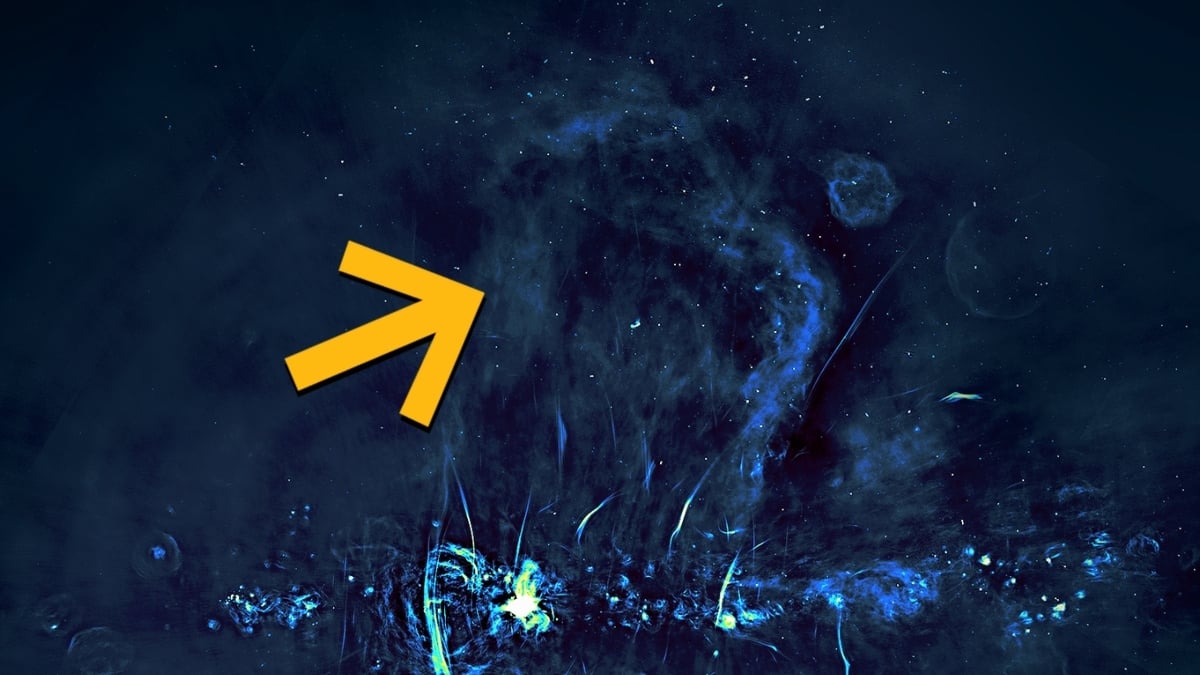
Scientists have recently clarified the nature of a mysterious structure in the Milky Way called the Galactic Central Lobe (GCL). This feature, previously thought to be a lobe extending from the galaxy’s center, is actually a closed loop situated about 6,520 light-years from Earth, much closer than the Milky Way’s true center at 26,000 light-years. Led by astrophysicist Kathryn Kreckel from the University of Heidelberg, the research proposes renaming it the "Highly Confused Loop."
The GCL has puzzled astronomers for 40 years, with various theories attributing it to phenomena like supernova remnants or ancient eruptions. The new findings suggest it is a bubble of ionized gas shaped by stellar activity rather than remnants of a black hole. The researchers used data from the SDSS-V Local Volume Mapper survey, which allowed them to observe ionized sulfur emissions that penetrated surrounding dust better than other wavelengths, revealing more about the GCL’s structure.
While still not identifying the specific stars causing the bubble, the team hypothesizes it may have originated from massive stars in a nearby stellar nursery, similar to Barnard’s Loop. Although smaller than other notable features like the Berners Loop, the discovery emphasizes how the Milky Way can obscure its own structures, highlighting the challenges in studying densely populated areas like the galaxy’s center. The study was published in Astronomy & Astrophysics.
