



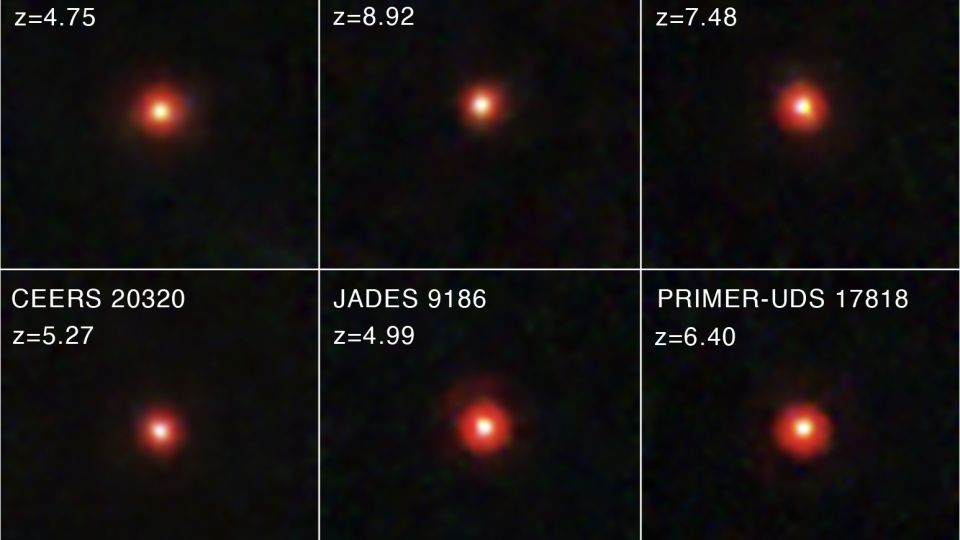
The James Webb Space Telescope (JWST) has captured numerous mysterious objects known as Little Red Dots (LRDs) during its observations. These bright red anomalies appear in many of JWST’s images, and astronomers are still debating their nature. Initially believed to be giant galaxies or dust-enshrouded black holes, these interpretations have evolved as more data has emerged.
Astronomer Jenny Green expressed that the unexpected nature of LRDs is a significant mystery in her career, stating that they may represent early black holes or dying stars. The LRDs observed are primarily located in the early universe, with scientists having identified about 1,000 of them, yet they are extremely rare in our vicinity. Recent discoveries of local LRDs suggest that they could be much less common than their distant counterparts.
The term “Little Red Dot” was coined in a 2024 study for its catchy nature compared to its scientific name. LRDs are red due to redshift and possibly because they are surrounded by hydrogen gas rather than dust. Research efforts, including the RUBIES program, have systematically tracked these red sources, leading to findings like the “Cliffs,” which challenge previous hypotheses and suggest the potential existence of new cosmic objects, including “black hole stars.”
Despite ongoing research, the community has not reached a consensus on the LRDs’ true nature, highlighting the complexities and unknowns in astrophysics. The JWST continues to inspire new questions and theories, reinforcing its role as a transformative tool in understanding the universe.
Source link
