



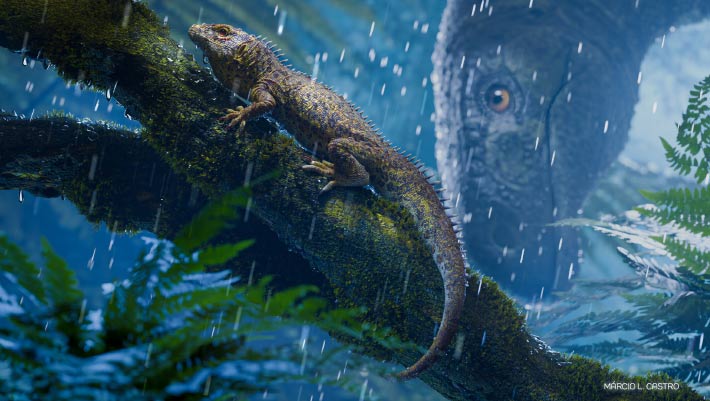
A recently discovered jaw fossil in southern Brazil is illuminating the evolutionary history of Cargninia enigmatica, a small lepidosaur that lived during the late Triassic, around 225 million years ago. This species thrived alongside early dinosaurs and primitive reptiles, but its precise place in the evolutionary tree has been unclear since its initial description in 2010 from a lower jaw fragment.
Cargninia enigmatica is part of the Lepidosauromorpha lineage, which eventually led to modern lepidosaurids. New fossils recovered from the Linha São Luis locality include an incomplete jaw with preserved teeth, suggesting it may have had up to 18 teeth. Researchers utilized micro-CT scans to study the internal structures and found that its neural branching patterns were similar to those of contemporary lepidosaurs, indicating it had comparable sensory capabilities.
Computational analyses placed Cargninia enigmatica as a non-lepidosaur lepidosaur, affirming its role as an early branch in lepidosaur evolution, prior to the appearance of true lepidosaurs. The findings are set to be published in The Anatomical Record.
