



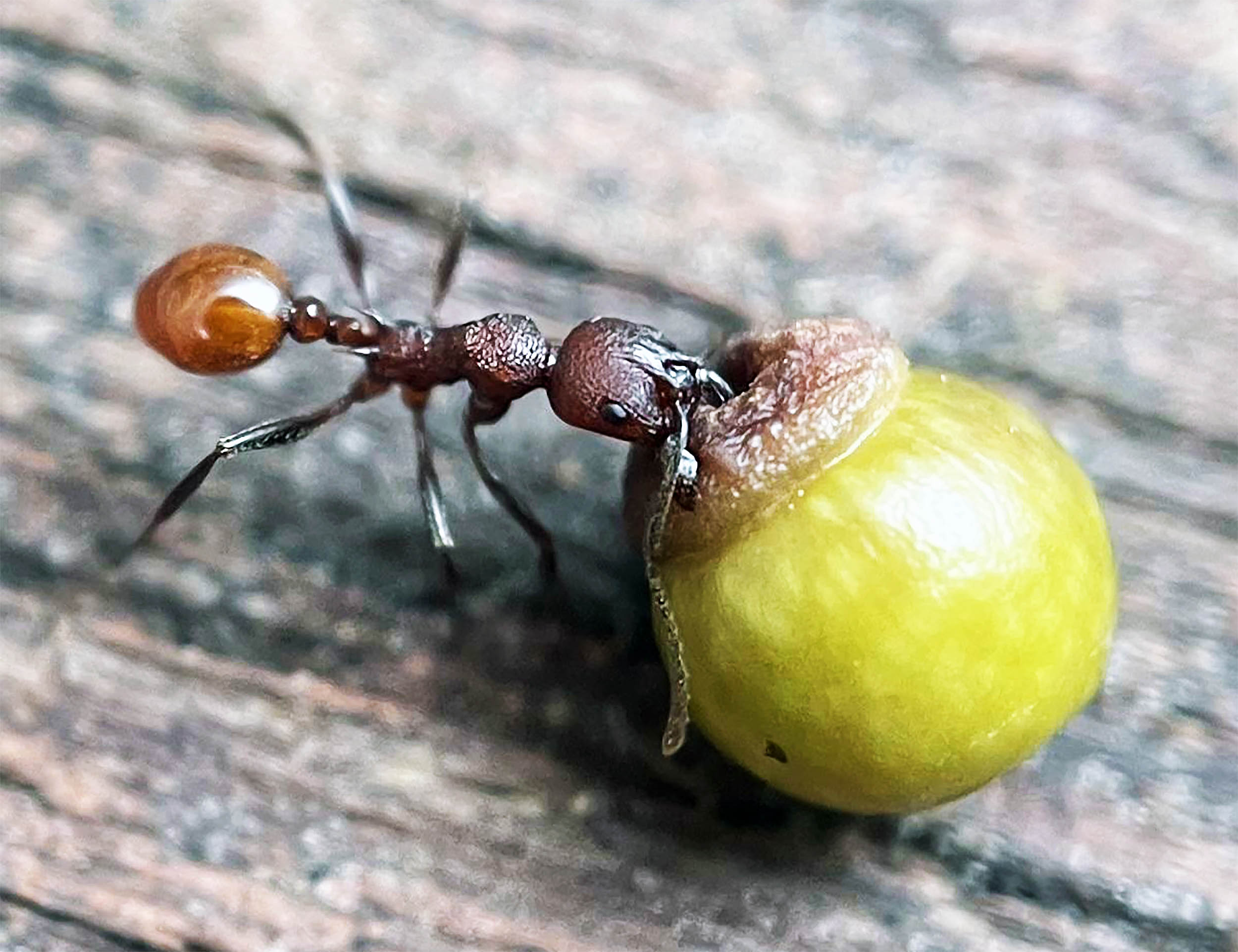
In late summer or fall, oak forests reveal galls, spherical structures caused by wasps, containing larvae. Researchers from Pennsylvania State University and SUNY uncovered an interaction where ants mimic seed gathering, taking galls home, consuming the outer layer, and leaving the larva intact. This discovery challenges long-held beliefs about plant-insect relationships.
In the study, ants treated galls similarly to seeds, attracted to a part called “capello,” which contains fatty acids that signal ants, akin to food cues from seeds. Different experiments showed that ants preferentially selected galls with capellos over naked galls or unrelated ones.
This interaction highlights a complex ecological network involving oaks, wasps, and ants, shaping habitats and nutrient distribution. It reveals how organisms can evolve similar strategies to exploit ecological relationships, emphasizing the hidden dynamics in nature that can substantially influence ecosystems.
Source link
