



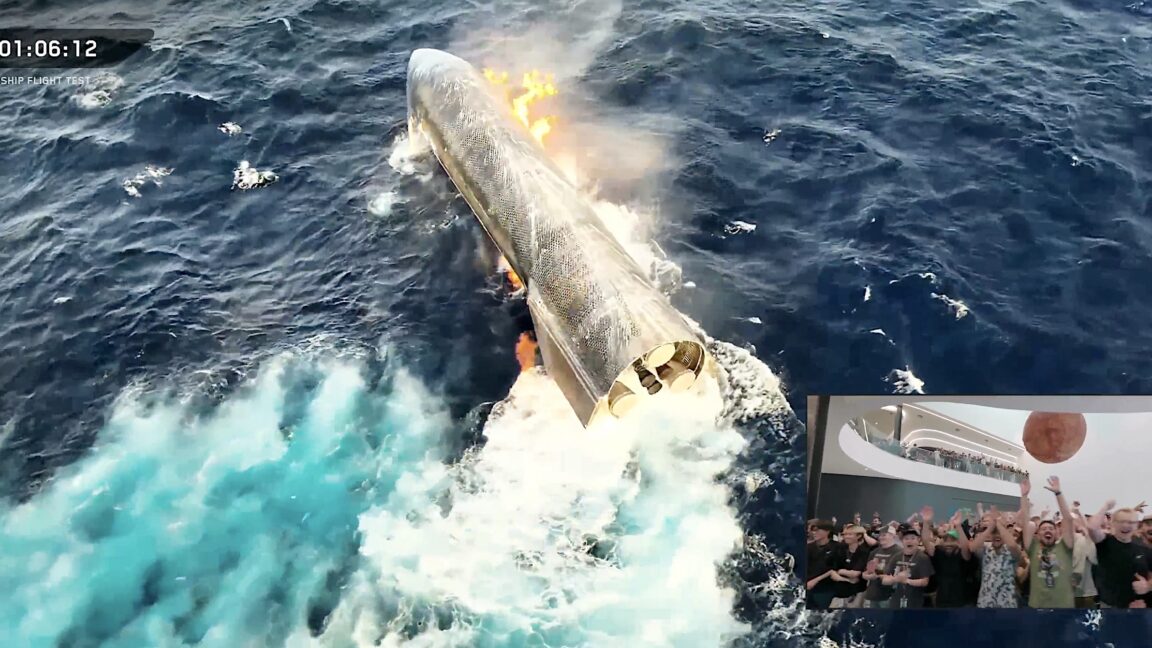
On Friday, SpaceX celebrated a significant milestone with the successful 13th full-scale test flight of its Starship, which landed intact in the Indian Ocean after a journey from South Texas. Unlike previous splashdowns that resulted in fires, this time the Starship capsized but remained buoyant and undamaged. Engineers inspected it with drones, finding the heat shield, composed of over 18,000 ceramic tiles, effectively withstood extreme temperatures during reentry.
Encouraged by this positive outcome, SpaceX plans to extend Starship’s capabilities in future flights, possibly aiming for low-Earth orbit and attempting to capture it using a launch tower. The previous flight’s checklist noted a need for a controlled splashdown of the super-heavy booster, which ultimately failed to restart its engines and splashed into the Gulf of Mexico at high speed.
During its flight, the Starship deployed 20 next-generation Starlink satellites, marking a first for the upgraded model and allowing SpaceX to gather valuable telemetry data before they disintegrated upon reentry.
The successful tests provide a pathway toward operational Starlink satellite launches and future missions, including NASA’s Artemis program related to lunar exploration. SpaceX continues to enhance its capabilities and efficiency with plans for in-orbit refueling, crucial for missions beyond low Earth orbit.
Overall, the mission reportedly collected significant data on the Raptor engines and heat shield performance, vital for the program’s iterative development process as SpaceX positions itself for further advancements in space technology.
Source link
