



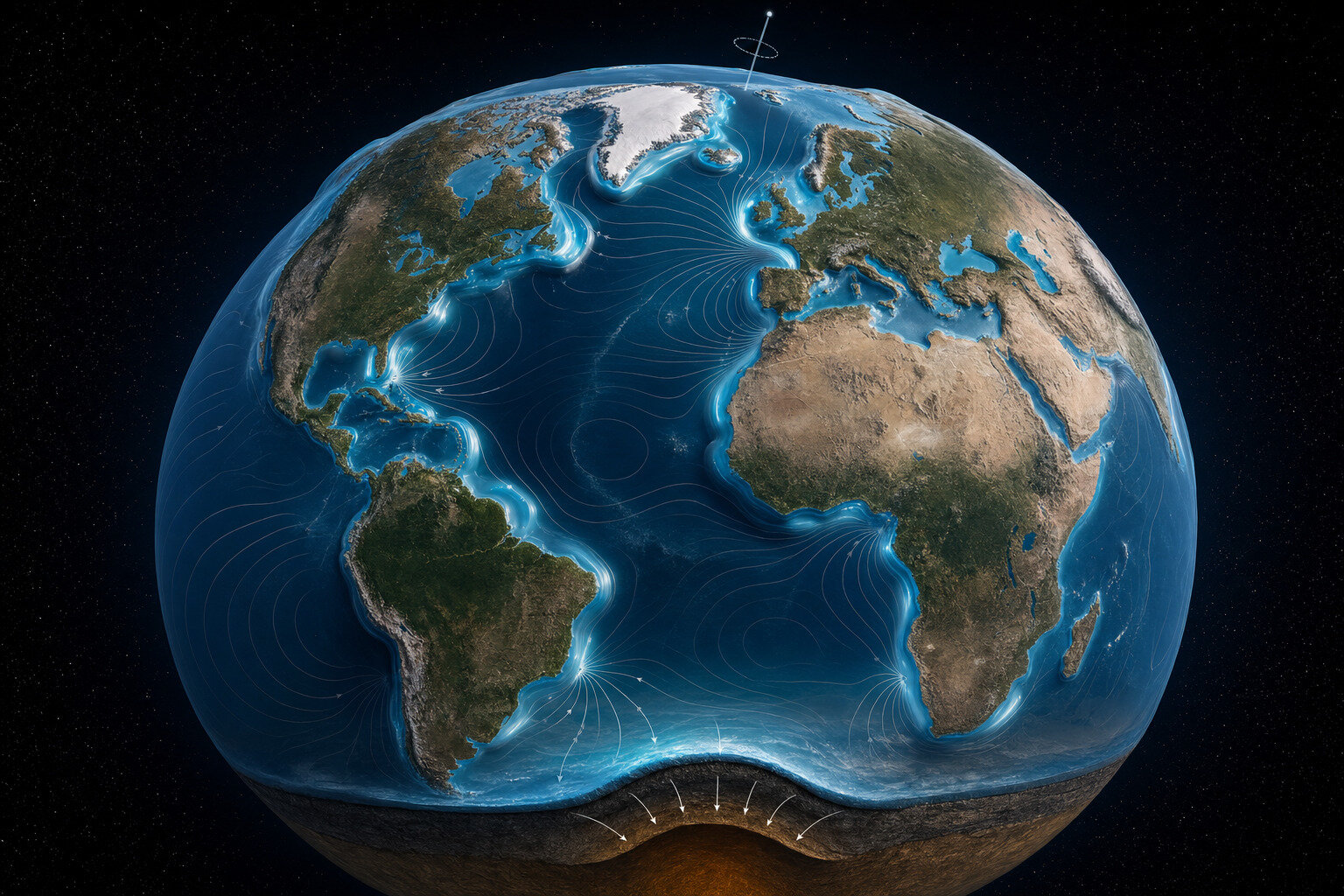
The article discusses how rising global temperatures are influencing sea levels beyond common factors like ice melting and thermal expansion. A recent study highlights the impact of Earth’s gravity and crust deformation on sea level changes, an area that has largely been overlooked in standard climate models.
Key insights include:
-
Gravity and Redistribution: As oceans warm, water density shifts globally, causing local variations in sea level due to changes in gravitational pull and seafloor deformation. This also affects the Earth’s axis of rotation.
-
Regional Impacts: Predictions suggest some coastal areas could experience up to 5 cm more rise by 2100 than previously forecasted, while other regions may see drops of up to 1 cm. The effects are especially pronounced along wide continental shelves and high-latitude coasts.
-
Underestimation of Risks: Ignoring these gravitational and tectonic effects could lead to a significant underestimation (about 15%) of sea-level rise, increasing flood risks for coastal cities.
- Call for Improved Models: The authors emphasize the importance of incorporating these dynamics into climate models to provide more accurate information for policymakers and urban planners.
In conclusion, this study reveals critical hidden factors affecting sea levels that must be considered for future climate assessments and planning.
