



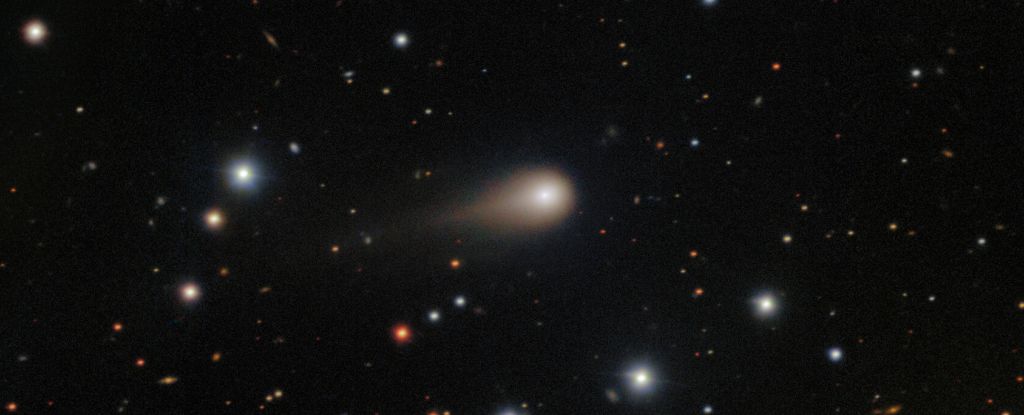
Recent observations of Comet 3i/Atlas using the Gemini South Telescope have revealed its developing tail and provided insights into its composition. Astronomers aimed to assess the color of the comet to understand the size and nature of its coma dust, along with chemical analyses through spectroscopy. The findings showed significant growth in the tail compared to previous observations, suggesting changes in its particle composition.
Comets, defined as rocky bodies covered with frozen materials, exhibit tails when nearing the Sun due to sublimation, releasing gas and dust. Unlike other known interstellar objects like 1i/’oumuamua and 2i/Borisov, Comet 3i/Atlas distinguishes itself by becoming active at a higher distance and having a unique composition with a rich concentration of carbon dioxide ice, which sublimates more readily than water ice.
The observations indicate that 3i/Atlas has two distinct tails—one ionized by solar wind—and its closest encounter with Earth will occur post-perihelion. This comet serves as a significant scientific milestone, reminding us of the dynamic nature of our galaxy and the lasting impacts of even transient interstellar visitors. Further analysis of its tail composition is ongoing.
Source link
