



Scientists have identified the source of three mysterious signals originating from the Milky Way’s center, attributing them to a unique form of dark matter called “excited dark matter.” This elusive substance, which constitutes about a quarter of the universe, cannot be directly observed but is believed to affect the behavior of galaxies. Lead researcher Dr. Shyam Balaji noted that traditional explanations for stellar explosions do not fully account for the energy signatures from the galaxy’s center.
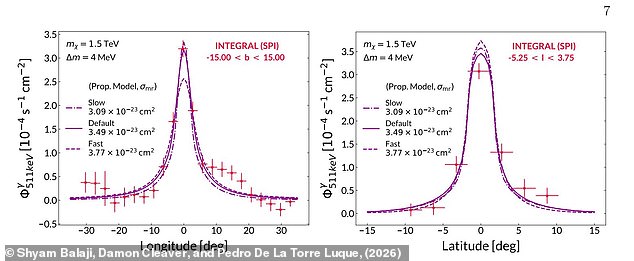
The Milky Way’s center is chaotic, featuring a supermassive black hole named Sagittarius A*. Among the strange phenomena observed is a specific spike in gamma-ray radiation at the 511 keV emission line, which deviates from conventional astrophysical expectations. The researchers propose that when dark matter particles collide, they briefly ascend to a higher energy state and then release energy as they return to normal, emitting positrons, which create detectable gamma-ray signals.
Further analysis from the European Space Agency’s INTEGRAL mission supported the idea that positrons from excited dark matter could explain not only the 511 keV signal but also the high-energy 2 MeV gamma-ray continuum observed in galactic centers. Additionally, they suggested that this model could clarify previously unexplained ionization levels in a dense gas region near the galaxy’s center, known as the central molecular zone.
This research promises a new understanding of dark matter and could guide future studies, potentially confirming whether this peculiar substance is responsible for these astrophysical mysteries.
Source link
