



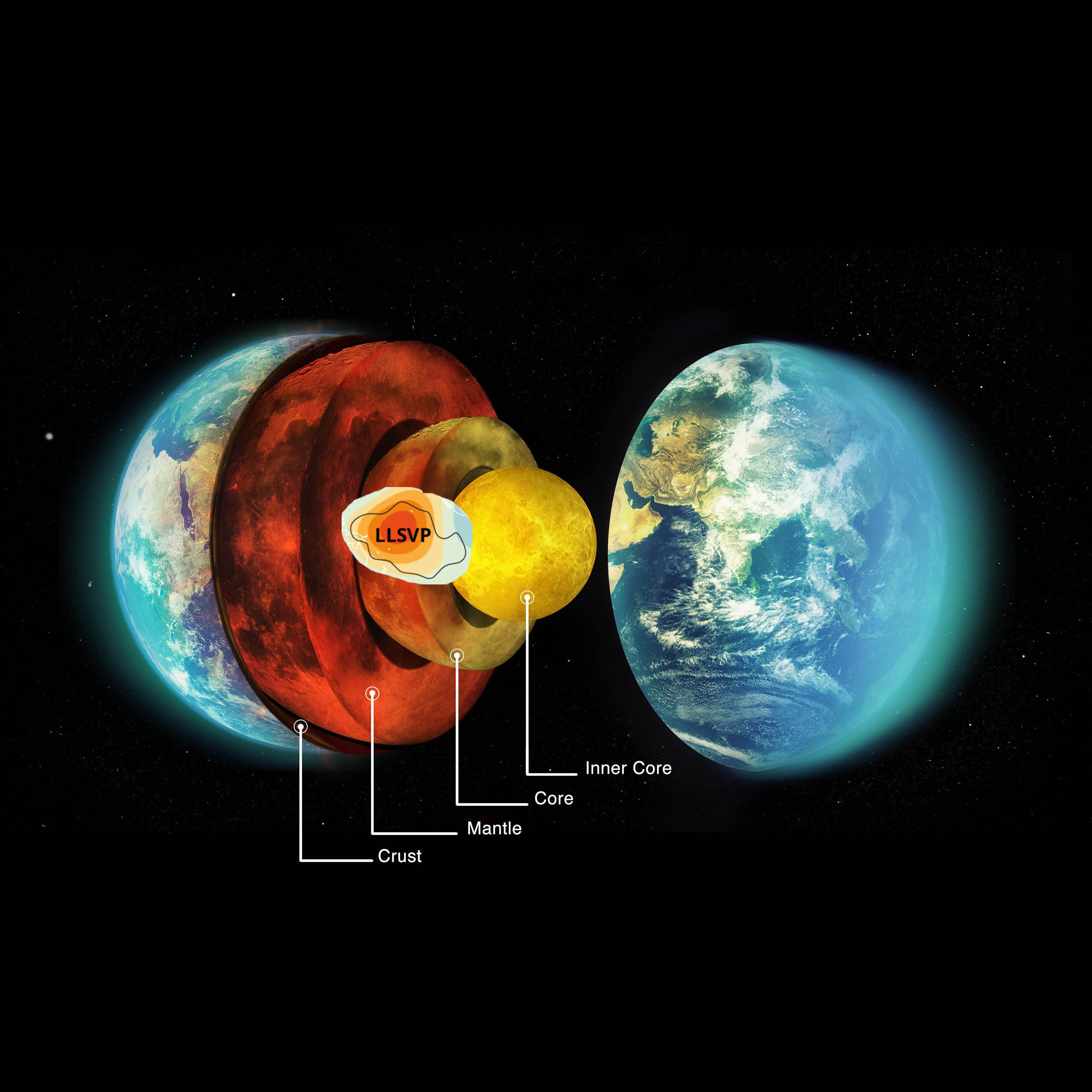
Scientists have discovered two massive regions within Earth’s mantle, termed “islands,” that are hotter and significantly older than their surroundings, dating back at least 500 million years. This finding from Utrecht University challenges the prevailing belief that the mantle is a well-mixed, rapidly flowing system, suggesting instead limited flow.
Located 1,200 miles deep beneath Africa and the Pacific Ocean, these regions, identified through seismic analysis, are classified as Large Low Seismic Velocity Regions (LLSVPs). Seismological studies revealed that while these areas slow down seismic waves due to their high temperatures, they surprisingly do not attenuate them significantly, contrasting with the behavior of cooler subducted plates.
This new insight indicates that the LLSVPs are composed of larger mineral grains, allowing seismic waves to pass with minimal energy loss. Their stability and ancient nature imply that they are not part of mantle convection and challenge the notion of a homogeneously mixed mantle.
Understanding these structures is crucial for interpreting geological phenomena like volcanic activity, as mantle plumes are believed to originate at the edges of LLSVPs. This discovery transforms our understanding of Earth’s internal dynamics, emphasizing the complexity of the mantle’s structure and its impact on surface geology.
Source link
