



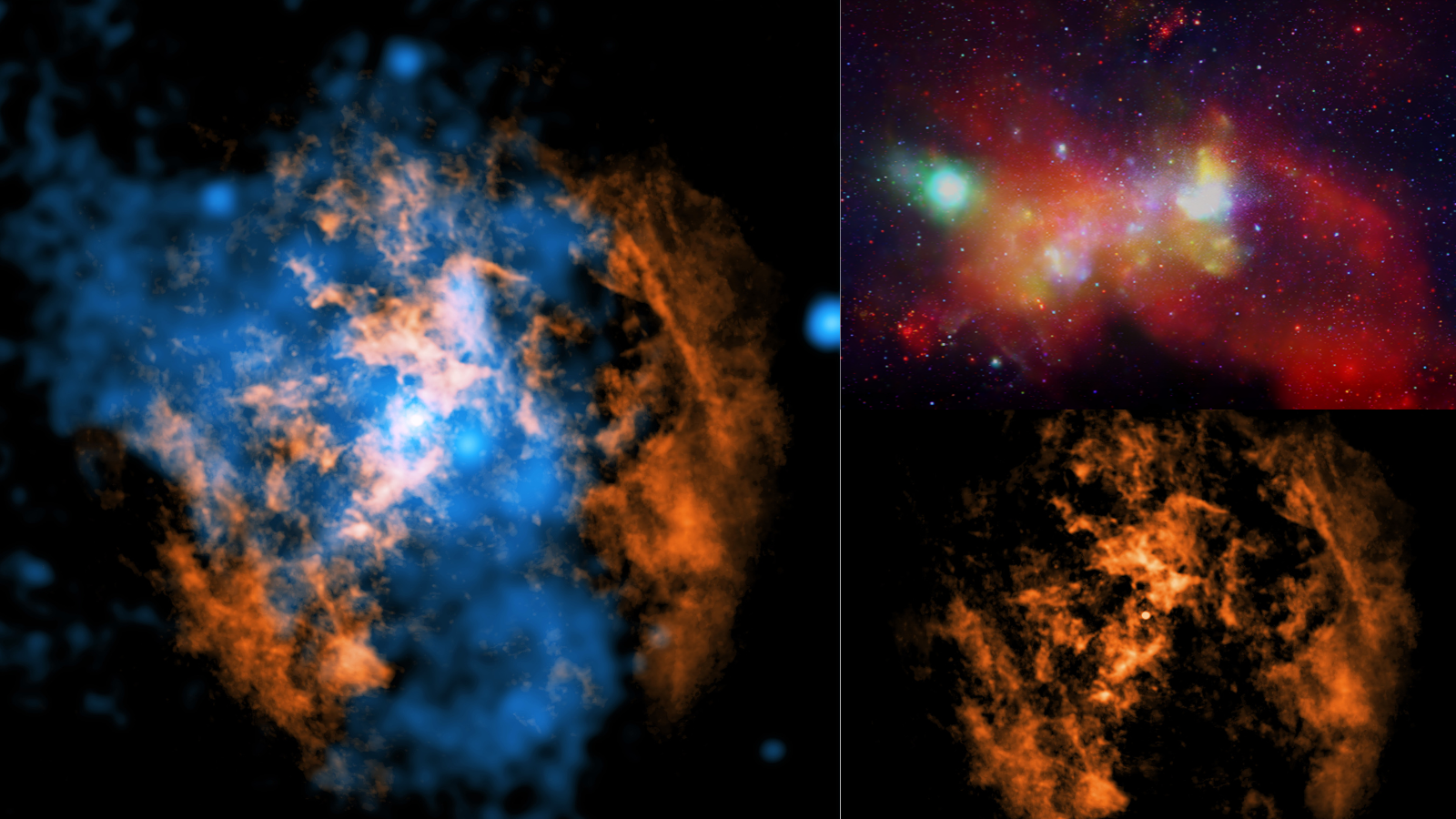
Astronomers have made a groundbreaking discovery after 50 years of searching by detecting powerful winds from Sagittarius A (Sgr A), the supermassive black hole at the center of the Milky Way. This finding enhances our understanding of both the physics surrounding supermassive black holes and the heart of our galaxy. Scientists have theorized that black holes generate energy by consuming matter, leading to a phenomenon known as "black hole winds." The challenge has been to gather evidence of these winds, particularly from Sgr A*, which consumes matter at an incredibly slow rate—roughly equivalent to a human eating a grain of rice every million years.
Despite the longstanding mystery, new observations finally provided the clarity needed to identify wind signatures from the black hole. The team used five years of data from the Atacama Large Millimeter/Submillimeter Array (ALMA) to create the sharpest image of cold molecular gas around Sgr A*, leading to the discovery of a cone-shaped cavity likely formed by gas pushed out by the black hole’s winds. They confirmed these results using data from NASA’s Chandra X-ray Space Telescope, showing X-ray emissions that aligned with the observations of cold gas.
Interestingly, while Sgr A* is quieter compared to more active black holes in other galaxies, it has been emitting winds for approximately 20,000 years. This discovery provides new insights into the less-explored, quieter state of black holes that contrasts with the more frequently observed, explosive active states. The research was published in The Astrophysical Journal Letters.
