



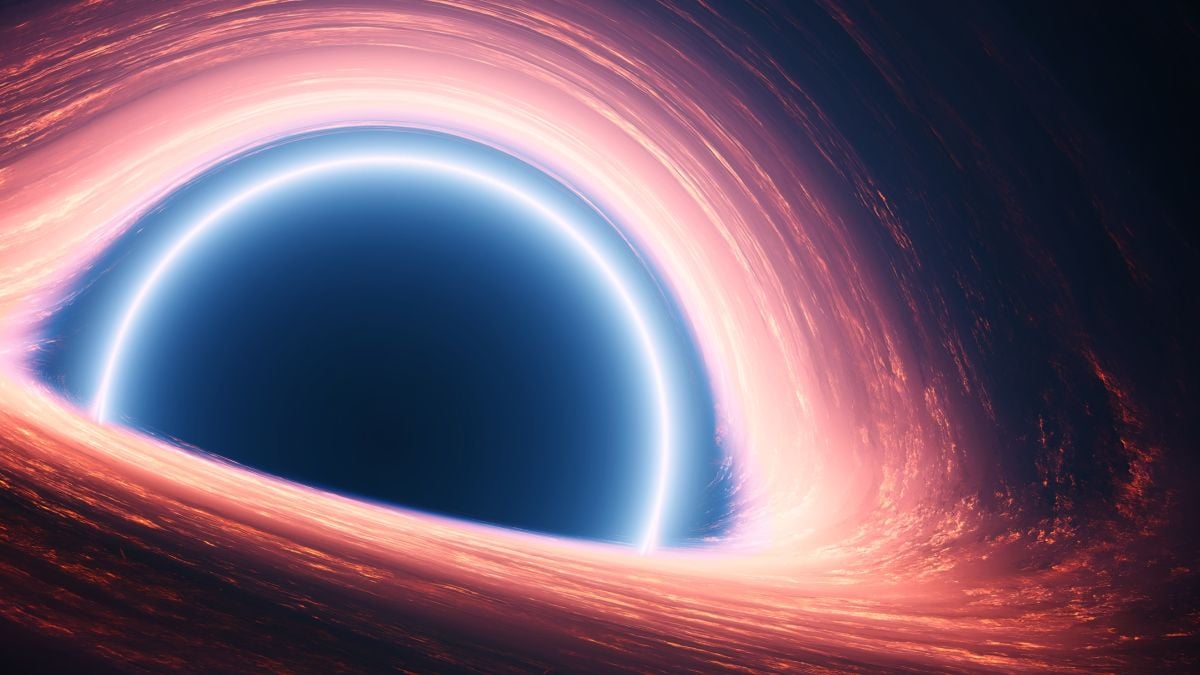
A recent study led by physicist Lorenzo Procopio from the University of Paderborn has observed an analogue of Hawking radiation back reaction in a light-based black hole model. Since the 1970s, Hawking radiation has been thought to be a method through which black holes lose energy, although the precise mechanism remains unclear. The researchers used a specially designed optical fiber to recreate an event horizon and detected subtle energy losses—akin to Newton’s third law where every action has a reaction.
Previous assumptions suggested that Hawking radiation results from complex interactions; however, their findings indicate it might stem from a direct process. This simplification could enhance understanding of how black holes emit radiation and might contribute to resolving longstanding theoretical issues, including the information paradox that Stephen Hawking grappled with until his death in 2018. Observing this mechanism in real black holes remains challenging, but these experiments may pave the way for further insights into the fundamental nature of black holes and their radiation. The results were published in Nature.
