



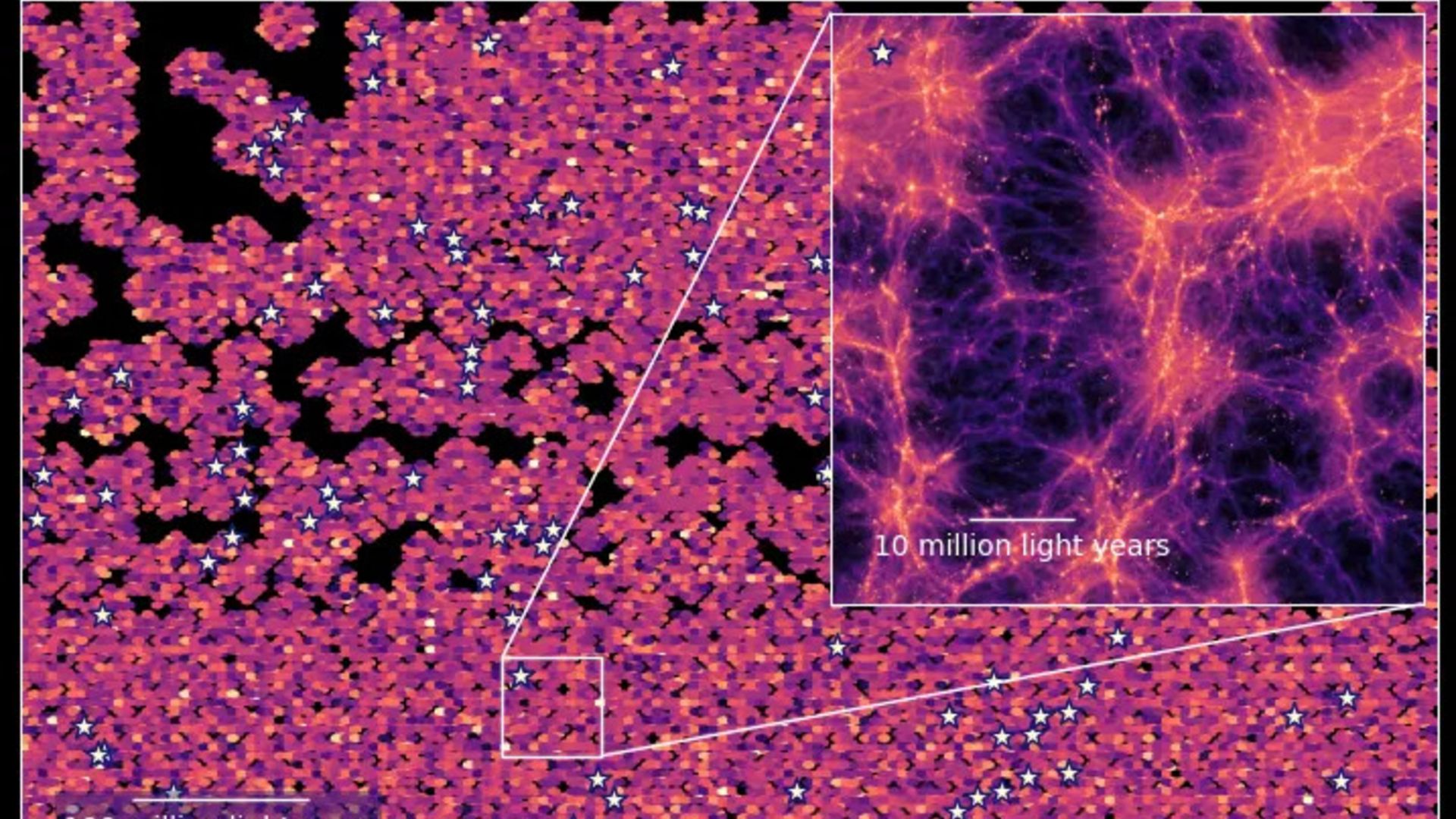
Astronomers have developed one of the most precise and detailed maps of the universe, showcasing a vast “ocean of light” from hydrogen, the universe’s simplest and most abundant element. By analyzing light emitted from excited hydrogen during a period of intense star formation 9 to 11 billion years ago, researchers created a 3D representation. This work, part of the Hobby-Eberly Telescope Dark Energy Experiment (HETDEX), aims to understand how dark energy and gravity influence the universe.
Using a technique called line intensity mapping, the astronomers can chart hydrogen’s light emissions, allowing them to map dim galaxies and large interstellar gas clouds. This method provides a broader view in cosmology, integrating data from numerous galaxies and gas clouds without focusing solely on the brightest objects.
HETDEX has amassed over 600 million spectra, covering an area larger than 2,000 full moons, offering unprecedented datasets for studying galaxy clustering and the distribution of mass in the universe. These new findings will enhance understanding of gravity’s role and dark energy’s effects on cosmic expansion, despite challenges in filtering out weak signals from background noise. Researchers are eager to refine their techniques and further exploit upcoming instruments to advance universe mapping.
Source link
