



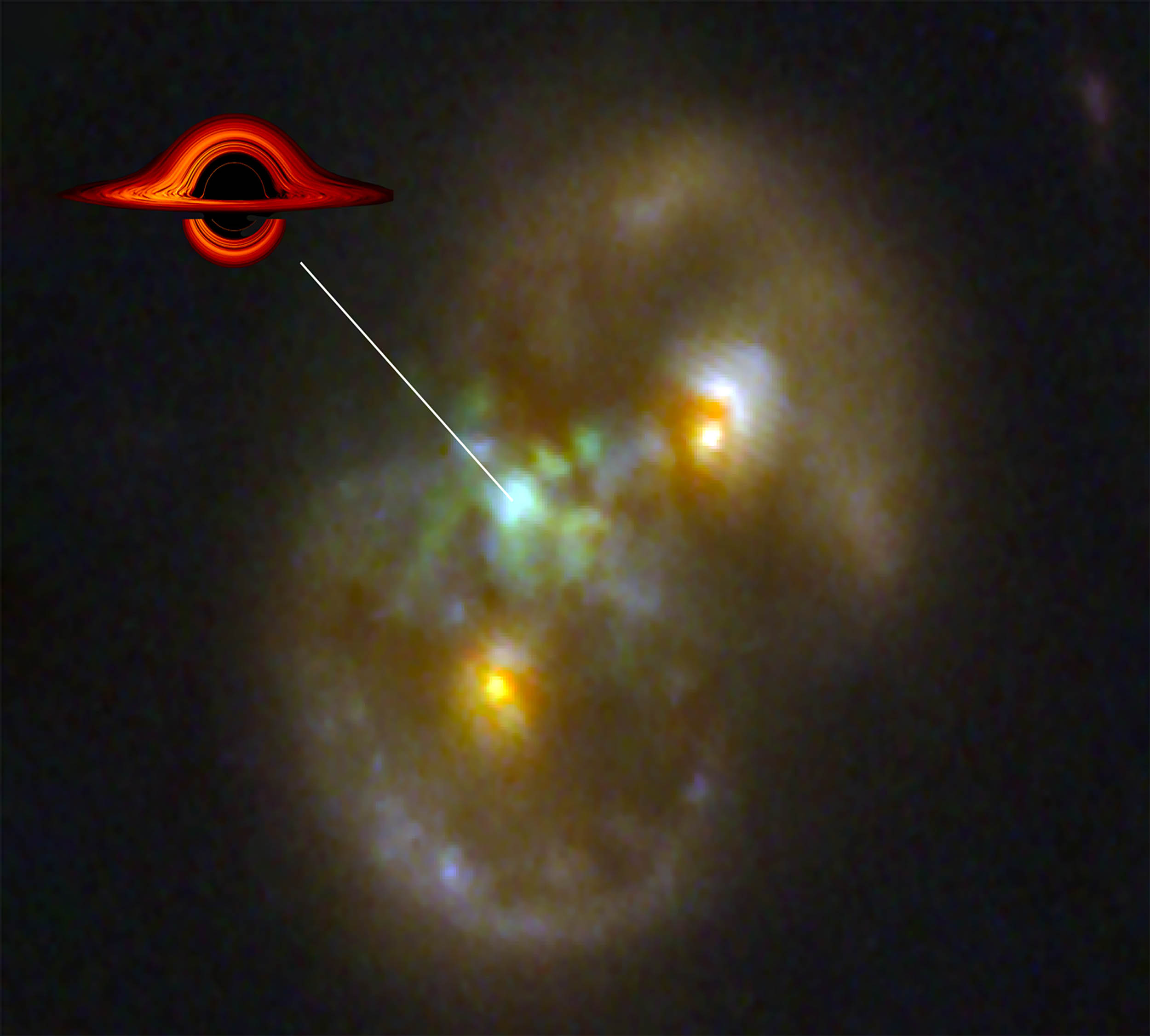
Astronomers are utilizing data from NASA’s James Webb Space Telescope (JWST) to discover unique cosmic phenomena, including a newly identified system termed the “infinite galaxy.” This unusual structure appears as a horizontal figure eight and consists of two galactic bulges separated by about 33,000 light years, each containing around 100 billion stars.
The researchers, Peter van Dokkum and Gabriel Brammer, found that this system is the result of a cosmic collision between two galaxies, leading to the formation of a new supermassive black hole located in a central region rather than within the bulges themselves. This finding is unexpected, as black holes typically reside at the center of galaxies.
Multiple observations, including spectroscopy, radio, and X-ray data, revealed signs of an actively feeding black hole. The spectral data indicated high-energy activity typically associated with such black holes. The researchers also discovered significant amounts of ionized gas between the bulges, hinting at a complex gas structure resulting from the merger.
The study suggests that the black hole may have formed through a process called “direct collapse,” where collapsing gas creates a black hole prior to forming stars. The collision is estimated to have occurred around 50 million years ago. Further research is needed to explore this phenomenon more deeply. The findings were published in The Astrophysical Journal Letters.
Source link
