



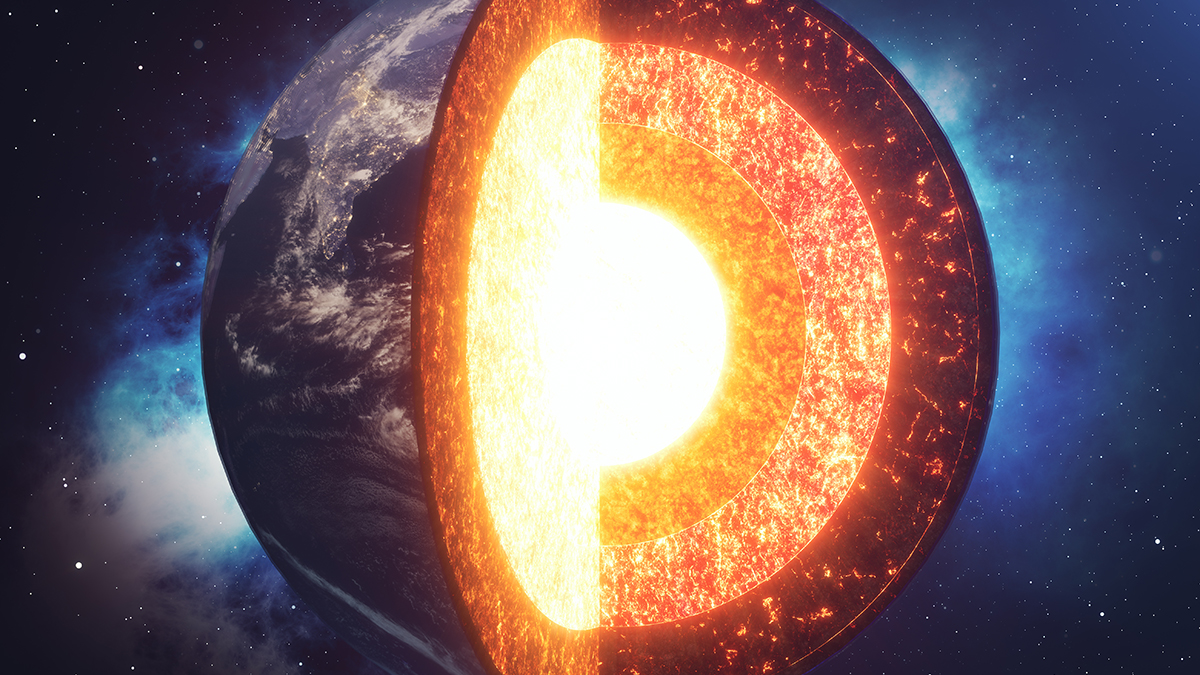
New research has shed light on Earth’s inner core, revealing that it may have an onion-like layered structure. German scientists investigated seismic wave anisotropy, which refers to the varying speeds of seismic waves based on their travel direction through the inner core. They studied the effects of silicon and carbon on the deformation behavior of iron under extreme conditions.
Using a diamond anvil cell to simulate high pressures and temperatures, the researchers measured lattice-preferred orientation (LPO)—how crystals align in solids. This alignment can influence how sound waves pass through metals, potentially explaining seismic anisotropy. Their experiments showed that adding silicon and carbon changes the crystal lattice of iron, leading to altered seismic wave velocities.
The findings suggest that the inner core is low in silicon and carbon at its center, resulting in strong seismic anisotropy, while outer layers gradually increase in these elements, reducing anisotropy. This research enhances understanding of the complex layers beneath Earth’s surface, primarily through seismic wave analysis and laboratory simulations under core-like conditions. The study, published in Nature Communications, supports the idea of chemical stratification in the inner core after its crystallization.
