



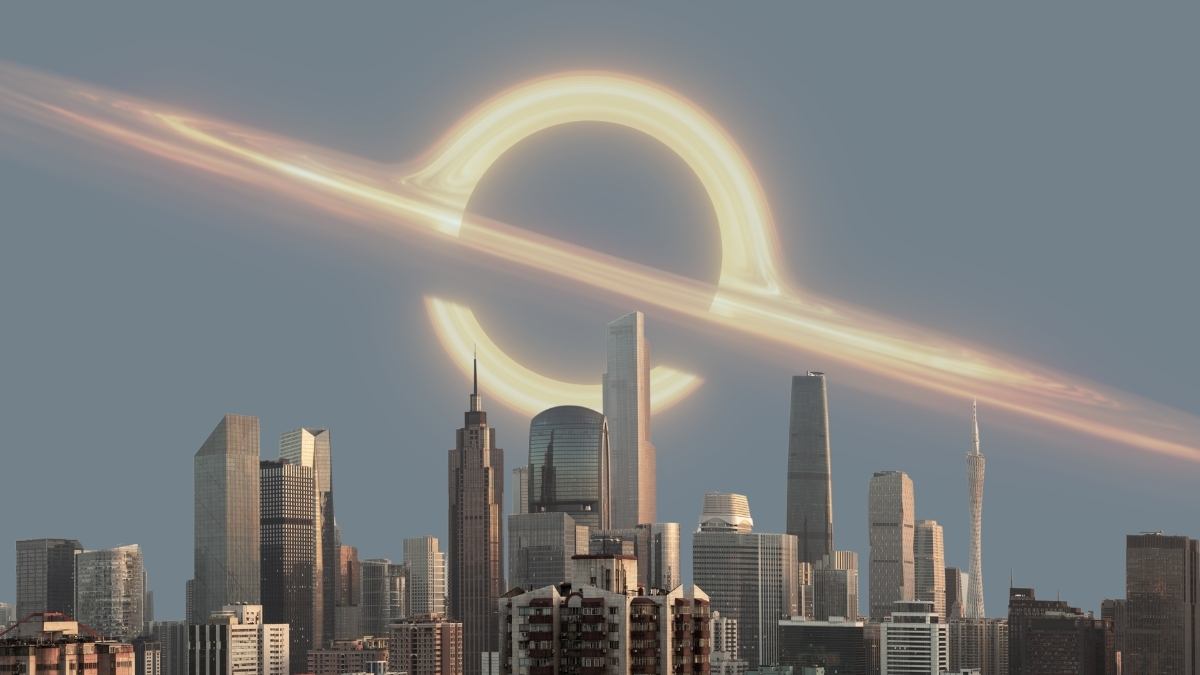
Astronomers recently explored the intriguing possibility of runaway black holes, propelled through space at extraordinary speeds. Last year, the excitement stemmed from an asteroid traveling through our solar system at about 68 kilometers per second. The conversation turned to hypothetical runaway black holes moving upwards of 3,000 kilometers per second, which could significantly alter planetary orbits without warning.
The notion of runaway black holes dates back to the 1960s, stemming from Roy Carr’s work on spinning black holes under Einstein’s general relativity. This led to the “hairless theorem,” stating that black holes can be identified only by mass, spin, and charge. Energy can also be stored as rotational energy in black holes, with significant amounts being released during black hole mergers.
Updated observations of gravitational waves since 2015 from LIGO and Virgo have bolstered these theories, revealing that merging black holes can emit energy and potentially generate a “kick” that propels them at tremendous speeds. Recent discoveries, supported by images from the James Webb Space Telescope, indicate the presence of runaway black holes. For instance, a study highlighted a galaxy with a bright, straight contrail—suggestive of a black hole moving at about 1,000 kilometers per second and possessing ten million solar masses.
Such black holes could create new stars in their wake, as gravitational compression from their movement pulls gas and dust together. Although the discovery seems daunting, the likelihood of a runaway black hole approaching our solar system is minimal, adding richness and complexity to our understanding of the universe.
Source link
