



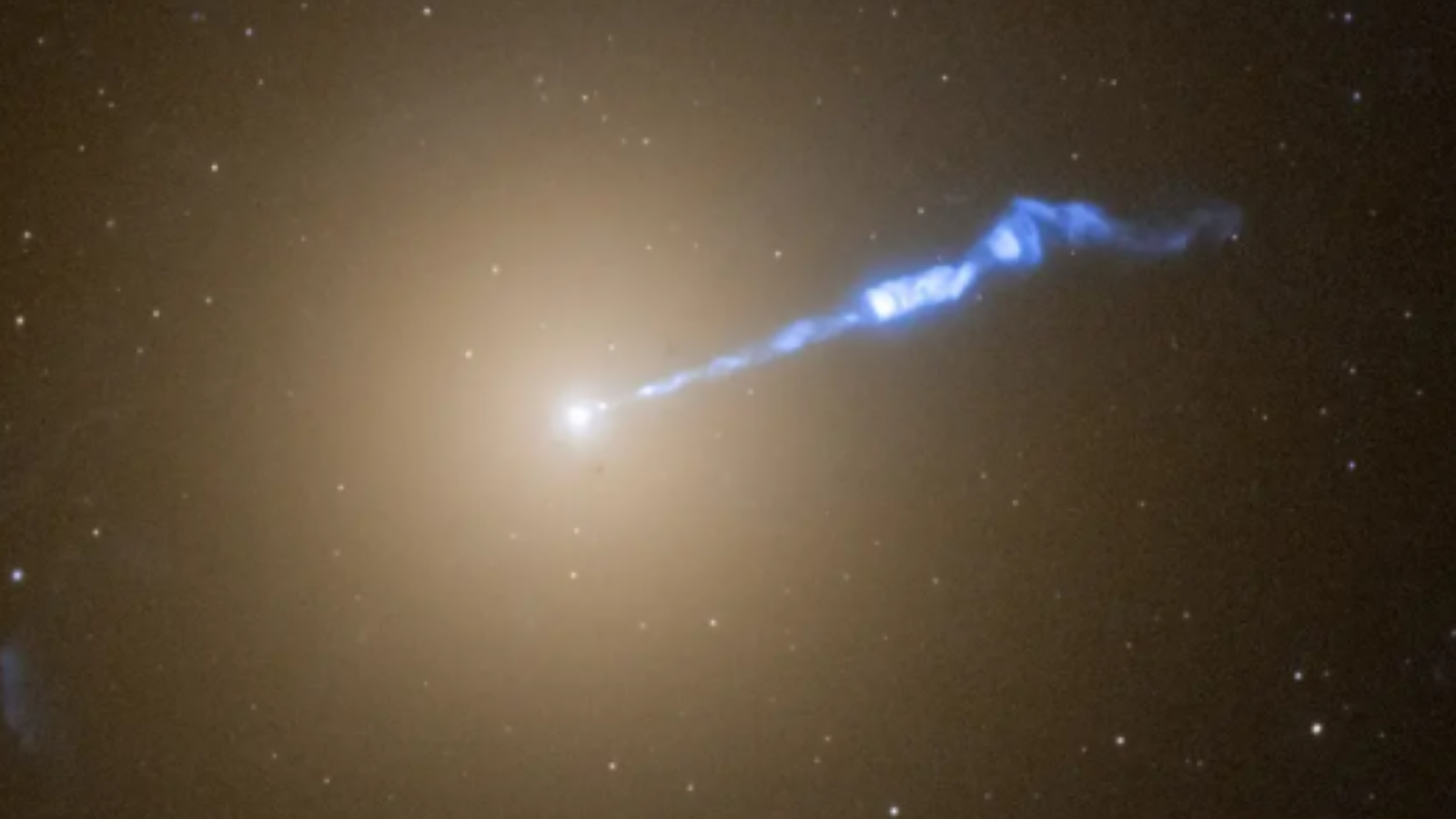
Astronomers utilized the Event Horizon Telescope (EHT) to trace a cosmic jet approximately 3,000 light-years long back to its source, the supermassive black hole M87. Located 55 million light-years from Earth in the galaxy Messier 87, M87 is notable for being the first black hole ever photographed. The image, released in April 2019, showed a mass equivalent to 6.5 billion suns, making it much larger than the black hole at the Milky Way’s center, Sagittarius A*.
M87 is an active black hole that emits powerful jets and consumes surrounding gas and dust, but the exact mechanism behind these jets is still unclear. To delve deeper, astronomers applied very long baseline interferometry (VLBI) in 2021 to better observe M87‘s structure, linking the glowing ring surrounding the black hole to the base of its jet. This connection aids in understanding the jet’s origin in relation to the black hole’s shadow.
Saurabh, team leader at the Max Planck Institute for Radio Astronomy, expressed that the findings help bridge theoretical concepts of jet launches with concrete observations. The team will continue to study M87* to further clarify the jet’s structure and its role in the black hole’s environment. Their results were published in "Astronomy & Astrophysics."
