



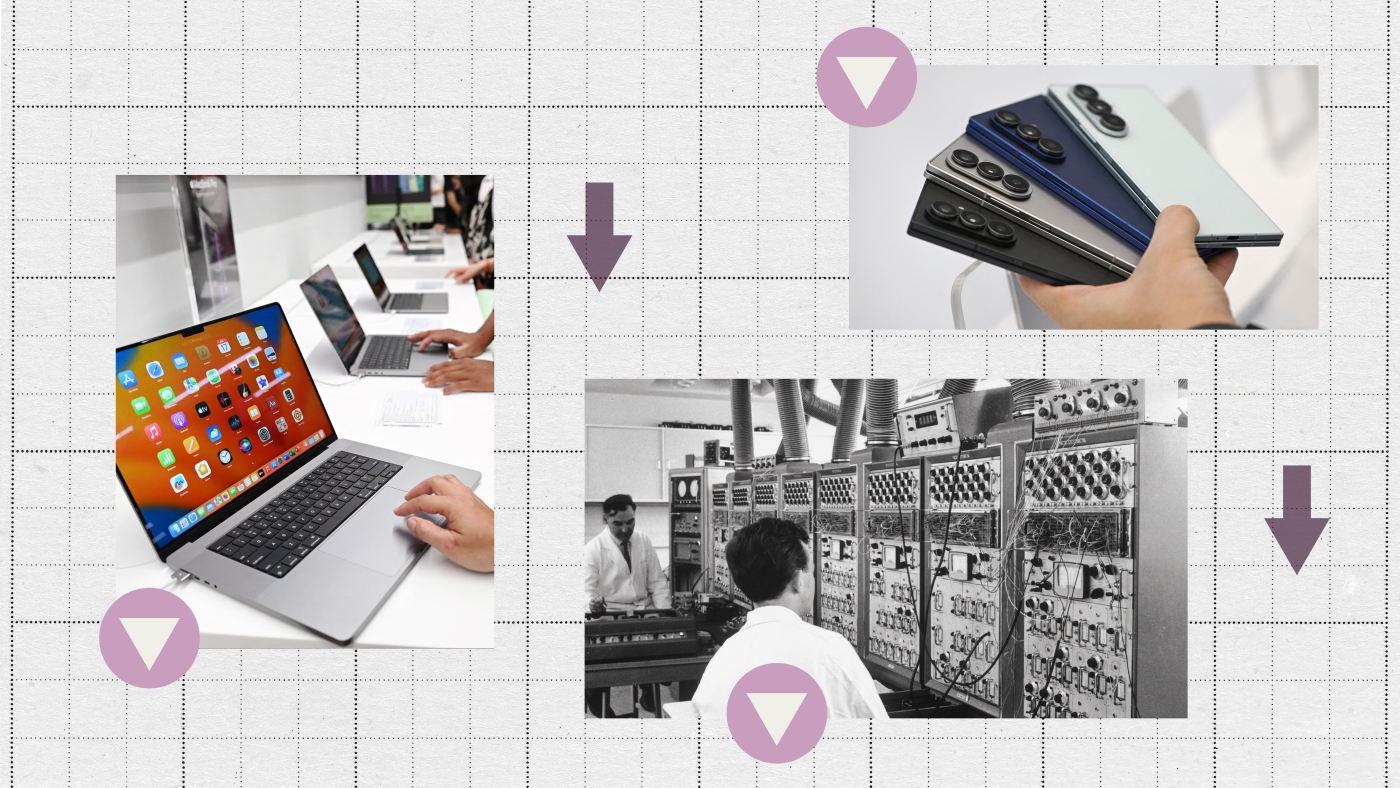
The article discusses the trend of falling prices in computing despite rising costs in other sectors, largely due to technological advances. Notably, the price of entry-level devices like the MacBook Pro has decreased from $1,799 five years ago to $1,599 today, attributed to factors like Moore’s Law. This principle, proposed by Intel co-founder Gordon Moore, states that the number of transistors on a microchip doubles approximately every two years, leading to cheaper and more powerful computing solutions.
Historically, computing costs have lowered significantly, enabling compact devices with capabilities far exceeding early computers. For instance, modern laptops have thousands of times the memory of 1960s mainframes at a fraction of the cost. However, experts warn that Moore’s Law may be reaching its limits as transistors become minuscule, and heat management becomes a concern. Future efficiency gains may depend more on software optimization and innovative chip packaging rather than sheer miniaturization.
Overall, while consumers have enjoyed decreasing prices and increasing capabilities, the outlook for continual price drops may be less certain moving forward.
Source link
