



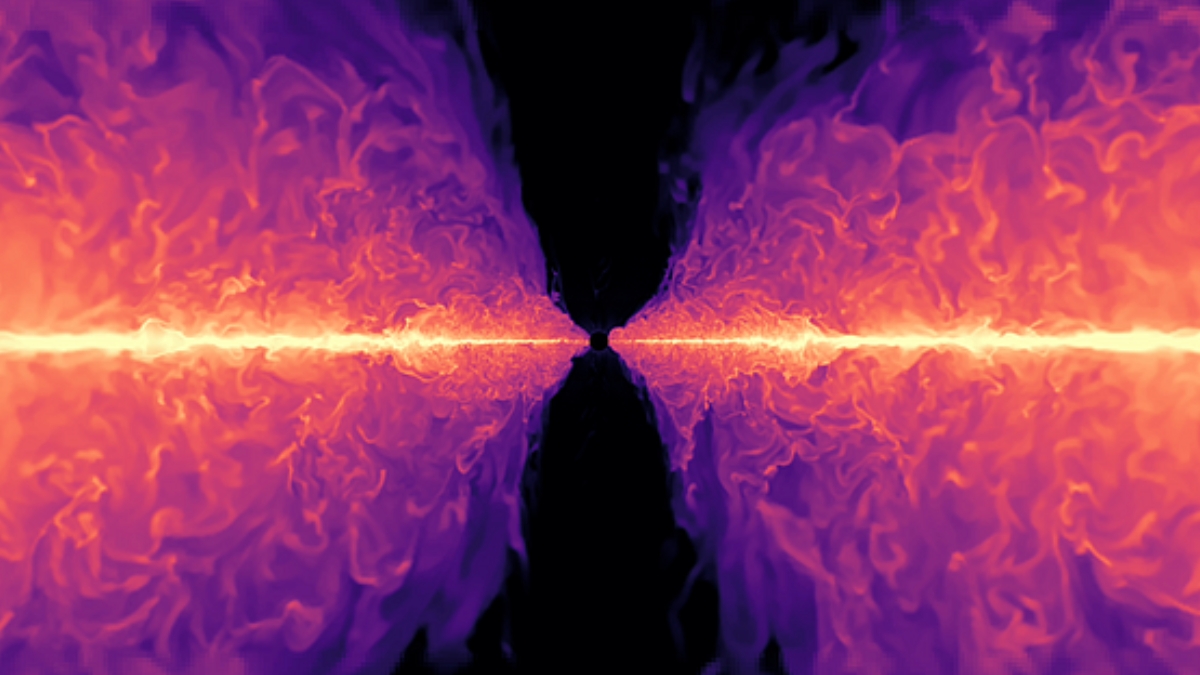
A new study from the Flatiron Institute presents the most detailed simulation yet of how a stellar-mass black hole consumes matter and ejects it at varying speeds. The simulations move beyond simplifications used in previous models, providing a more accurate depiction of the chaotic boundary region of black holes. Utilizing two powerful supercomputers and data on black hole accretion flows, spin, and magnetic fields, the researchers revealed that the gas disk around a fast-spinning black hole becomes denser at its center and generates powerful jets influenced by magnetic fields.
These simulations showed that black holes can form thick accretion disks that absorb vast amounts of radiation, releasing energy via winds and jets. Notably, they highlighted how narrow funnels develop, capturing matter at incredible speeds while producing radiation observable only from specific angles. The innovative algorithm developed in the study treats radiation in line with general relativity and accurately models photon behavior in curved spacetime.
Looking ahead, the researchers aim to apply their findings to other black holes, including the supermassive Sagittarius A* at the center of our Milky Way, and potentially to explain recently discovered “little red dots” emitting less X-ray radiation than anticipated. The study was published in The Astrophysical Journal.
Source link
